

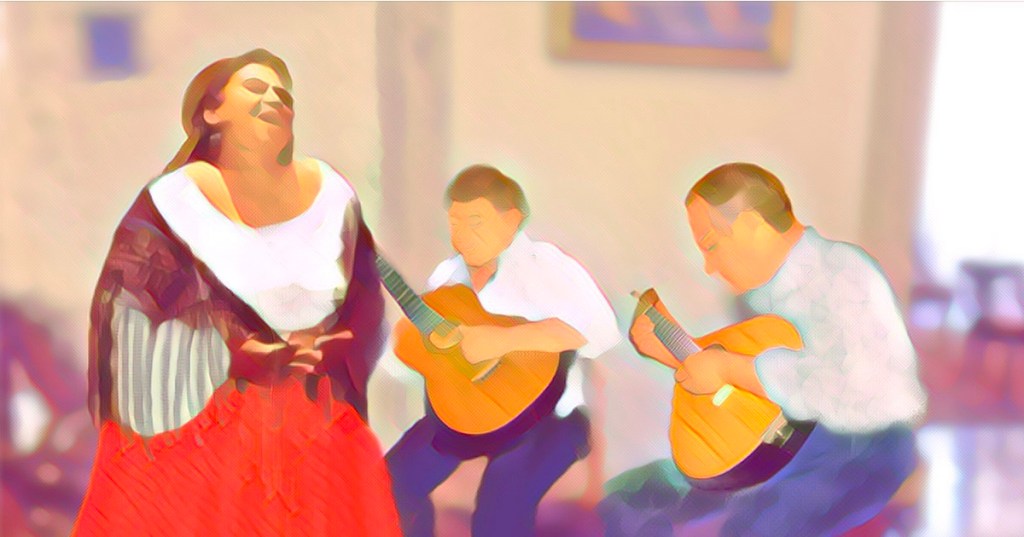
For me, singing sad songs often has a way of healing a situation. It gets the hurt out in the open into the light, out of the darkness.
― Reba McEntire
Our fourth musketeer, a.k.a. The Cranky Korean (TCK) is the first person I think of when I think of fado music. TCK was originally from Korea but had also lived for many years in Brazil, and the United States. Maybe it is having so many places to be homesick for that makes it so easy for him to connect to saudade. I think TCK is passionate, itching for surprise and adventure. He’s a calmer version of his younger self, still impatient but more compassionate. Now he’s trapped in an older body full of pain and aches and limitations. I think that’s where the cranky comes from, the frustration of living in a body that carries illness and injury into a world he wants so much more from. I think there is a part of him homesick for himself, too.
TCK arrived in Portugal already fluent in Portuguese and seemingly determined to go to every Fado House in the country. I did not join him on this mission, though I did admire it. While I failed to prioritize fado music while I was in Portugal, I do feel that it’s too important not to include when talking in any depth about Portuguese culture. Just understand that most of my research on fado music has been done online in California.
What I’ve been able to find on my own has been somewhat confusing and contradictory. Some sources say there are musical elements that spread south from Portugal to Northern Africa. Some sources say that these musical elements traveled north from Africa to Portugal. All seem to agree that the various elements came together in the culturally rich port city of Lisbon, largely among laborers, dock workers, and prostitutes and then spread (via prostitute) to the aristocracy.
I also found multiple sources keen to tell me that fado means fate in English. I have been unable to elicit any such translation from Portuguese-English dictionaries and translation apps. It certainly fits with the heartbroken tone of much traditional fado. This fourteen-minute video is my favorite of the overviews of the history of fado music that I found online.
My personal exposure to fado music was incidental other than a Cuca Roseta concert at the Coliseu Micaelense. This grand concert house was a far cry from the classic fado houses discussed above. Cuca Roseta is technical perfection. Every note lands exactly where she wants it to for as long as she desires, without deviation. I found her to be a remarkably seasoned pro, both as a singer and performer in general, especially for a woman who is still so young and beautiful.
Still it was a guest performer who stole the show for me. She was older, less flashy, less precise, but she broke my heart in a language I do not understand. With art I often care more about connecting emotionally than I do about technical proficiencies. I had a conversation with my daughter years ago when many of the other 6th grade girls were big fans of Justin Bieber. She wanted to fit in and support her friends’ passions and interests. But also, she was self-conscious about the idea of listening to a performer who was largely ridiculed by everyone who wasn’t a preteen girl.
I wanted to encourage my daughter to explore whatever music she was curious about, but was also honest about why I didn’t connect with his work. One of Bieber’s big hits is a song about having his heart broken for the first time and its absolute bubble gum. There’s no heart in it. Contrast that with the palpable ache with which Etta James sings about finding love. I’m going to pick the Etta Jameses and the Chavela Vargases and any other artist who can put their feelings into my soul. Every. Single. Time. I have big feelings and I want art that can match that magnitude.
I need art that can take the broken, shameful, most lost places we, as humans, find ourselves, and show me that I am not the only one who has been there. Show me that the feelings I don’t want to have ache in other people’s souls, too. We try so hard not show each other our soft underbellies, our failures and mistakes. I need art to show me that other people have been here too, and then, when I am mired in my own dark nights of the soul, I can believe that I will be okay in the end.
Cuca Roseta was somewhere in between the wounded and the pop stars. Obviously, she had more depth than a child superstar, and there were times when her joy was so easily felt, I forgot my discomfort with the setting entirely. She just never broke my heart vicariously.
That setting though; it was its own character in this story. The Coliseu Micaelense was originally built in 1917 and significantly repaired and renovated with a grand reopening in 2005. It’s a gorgeous building with all sorts of lush details inside. It’s also a roughly 1300 seat venue without any visible windows. In June of 2022, with the world barely open again after the pandemic lockdowns, this felt very claustrophobic to me.
I was fully vaccinated (a requirement for both school and travel at that time) and had chosen to live dangerously. I was living and studying with the same group of roughly 30 people day and night. The concert was no exception. If one of us got the ‘rona, it seemed fated that we would all succumb.
As the only full-time student in households where no one worked outside the home I was terrified of bringing more than homework back from school. I have a great track record of not dying so far. I’m willing to gamble a little longer on continuing that trend. My biggest fear peak-pandemic wasn’t that I might get sick but rather that I might get sick and give it to someone else.
That wasn’t a concern during study abroad. Still, I couldn’t help but be antsy. When part of the group had already gone in to explore the building and take their seats, I lingered outside with the smokers and other stragglers, half wondering if I could hold my breath for a whole concert.
Eventually, my anxiety about being in a poorly ventilated room with a thousand people was overshadowed by my anxiety about entering the same room disruptively late. After months of avoiding indoor crowds, of trying to sit near open windows in class whenever possible, I surrendered to my spot in the middle of a crowded concert hall. Cuca Roseta was engaging enough, that even surrounded by the maskless masses singing along, I quickly forgot to worry about anything and just enjoyed the show.
Guess there are times when we all need to share a little pain
And ironin’ out the rough spots
Is the hardest part when memories remain
And it’s times like these when we all need to hear the radio
‘Cause from the lips of some old singer
We can share the troubles we already know– Elton John
Sad Songs (Say So Much)


Leave a comment