

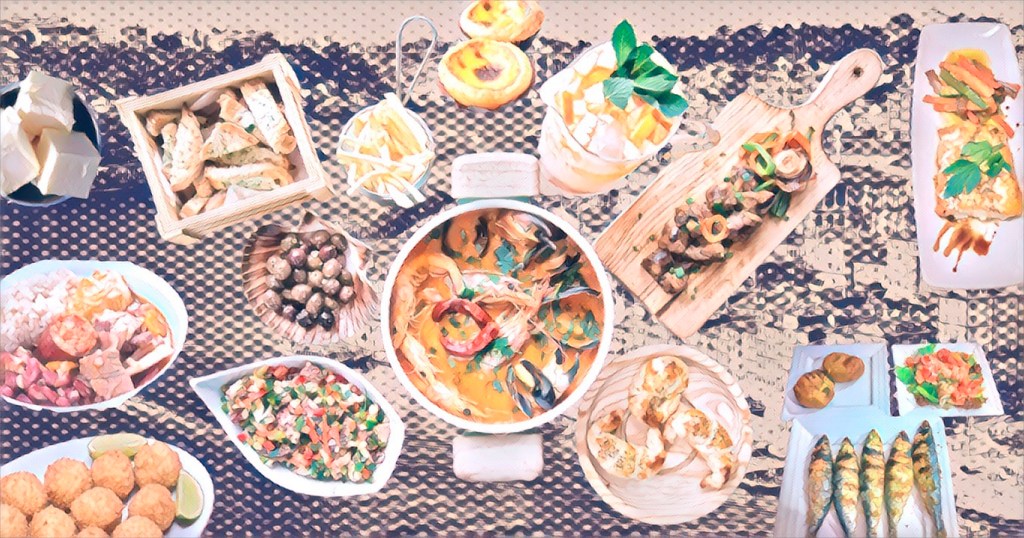
Do we really want to travel in hermetically sealed popemobiles through the rural provinces of France, Mexico and the Far East, eating only in Hard Rock Cafes and McDonalds? Or do we want to eat without fear, tearing into the local stew, the humble taqueria’s mystery meat, the sincerely offered gift of a lightly grilled fish head? I know what I want. I want it all. I want to try everything once.
Anthony Bourdain
Kitchen Confidential: Adventures in the Culinary Underbelly
Staying in Portugal for two months, while going to school, working remotely, and having a host of other adult responsibilities, I hadn’t set out to eat Portuguese food so much as I just needed to eat food, because staying alive and stuff. This was definitely a mistake. There are so many things I’ve had a hankering for since discovering them in Portugal. That may be one of the things I dislike most about moving. It seems like every new address has a new recipe catalog for my life because the stores have different ingredients.
At first there’s a frustration, because I want to make this or that but at least one key ingredient is inferior, or completely absent, in the new store. Then over time, I discover wonderful new ingredients in the new store and my menu planning evolves to the new space. Then I move again and what had been the new store that frustrated me is suddenly the old store that I miss.
Eating Out – São Miguel
Our first night in Ponta Delgada we were treated to a private feast at A Tasca This was a very informative feast with lots of iconic dishes whose history and importance were explained to us. I was jetlagged and overwhelmed and don’t remember much detail other than that this was the night that I learned that all cheese in the Azores is amazing, and that sangria comes in white, too.
A friend and I managed another meal at A Tasca, ordering from the menu, and it’s good food, but this is hardly a well-kept secret and the wait can be a lot. Still, I’m grateful to have sampled some high-end, properly Portuguese, food.
The other event level dining experience was going to Tony’s for cozido das Furnas. Once again, the tourists definitely know about this place, but it’s a good bucket list item to check off. I’m not a big fan of big, naked, chunks of meat and this was sort of like the Portuguese culinary equivalent of the American St. Patrick’s Day standard, corned beef and cabbage, but with rice, too. The portions are generous and there are lots of other delights like bread and butter and cheese so that even someone who doesn’t eat a lot of meat can waddle away well-stuffed.
If I go back to Furnas someday, I think I’ll just stick to the caldera cooked corn on the cob from a street vendor, and a sandwich (along with a few bags of bread, pastries and queijadas to go) from Padaria Glória Moniz. And of course, I’ll have to try new things. I always want to try new things.
That said, most of my meals ended up being a short rotation of homey comfort foods from the school cafeteria. The school food is heavily subsidized (which is to say quite cheap at the student end) and very satisfying. This is where I developed a deep love of bacalao baked in creamy potatoes. In addition to the full meals from the cafeteria there was a snack bar where I would frequently get a pastry and a drink, usually something espresso based. Even when I wasn’t at school, various pastries, some sweet, some savory, were indulged in at least once a day any day that I left the apartment.
The restaurants I frequented in the Azores were also very humble. Living in a university neighborhood seems to mean lots of pizza and hamburgers no matter what country you’re in. Our apartment was right around the corner from Pizzaria Estrela Da Noite. The first time we tried to go in, there were a bunch of older men sitting at the bar and we weren’t certain it would be proper for women to go in unchaperoned. It’s fine. It’s an odd little place with a full bar, a cigarette machine, a candy counter, and a pizzeria all in a room that didn’t feel any bigger than my living room, but it’s family friendly in its own way.
Eventually, I became something of a regular, using any excuse to pop in for a “baguete de atum e uma Kima,” which is to say tuna fish salad (and lettuce) on a small baguette with a Kima. Kima is an oddity. It’s carbonated fruit juice; while it comes in many flavors, I quickly became a devotee of the passionfruit (maracujá). It’s made by Melo Abreu, a local brewery, which, not surprisingly, mostly makes beer.
Café Central got a lot of our business by having the best hours. It took a minute for me to learn that running errands on Sundays was pointless. Almost everything was closed. If it was too late, too early, or too Sunday, we’d end up here. It’s very tourist friendly, in sort of a Denny’s meets fresh, simple Portuguese food kinda way. I think there was always at least one English speaker on shift. The food was good enough that I never minded going back, but not so special that I would have gone out of my way for it.
I wouldn’t consider myself to be a regular, but I did go out for sushi two or three times at Musaxi. It’s an all you can eat place where you choose a Chinese or Japanese menu when you arrive and tick off what you want. No matter how hungry I think I am going in, I rarely manage to eat my money’s worth at all you can eat places anymore.
Still, I do love sushi, and the fish was always very good, even though I found Portuguese sushi rice very bland. It was sticky enough but lacked that hint of vinegar that I love. I was also strangely excited to see California rolls on the menu. They aren’t the most exciting sushi (especially not with plain rice), but to see the word California on the menu, so far from home, made me bounce with delight. Who knew our rolls were global.
I didn’t eat nearly as much seafood as I should have while living on this Atlantic island. I did have the joy of discovering lapas. It hasn’t replaced baked green mussels as my favorite way to eat mollusks, but limpets (which look far less like Don Knotts than expected), bathed in Azorean butter and garlic, are a little taste of heaven on earth.


Home Food
That said, most of my meals in the Azores were simple things I threw together with groceries from Continente and/or Mercado da Graça (the local farmer’s market). Mercado da Graça is an attraction unto itself. It’s open Monday through Saturday (but not on Sunday). I believe Saturday is the day when the tuna is there. Those jars of tender tuna packed in olive oil have changed my relationship with shelf stable fish. Any time they’re open there is an amazing variety of fruits and vegetables of the finest quality. Continente is just a grocery store, but those are important.
I endeavored to, at the very least, always have tea, butter and bolos lêvedos in the kitchen. Bolos lêvedos are like what would happen if English muffins and pancakes had a delectable, versatile, lovechild. On São Miguel you can, and probably should, try almost anything that goes between bread on bolos lêvedos. Hamburgers, sandwiches made with meat and cheese, and simply toasted with butter and/or jam seem to be among the most common uses.
Azorean dairy products are incredible. As a person of Irish descent who has been to the Emerald Isle, it pains me to admit it, but I do think it is quite possible that the Azores have the best butter in the world.
Queijada was a curious thing that I’m still not sure how I feel about. Was it a sweet cheese? A hard custard? I don’t really know. But I would definitely eat more of it given a chance. If for no other reason than to figure out how to describe it adequately.
If I had it all to do again I would have started a cheese diary on my first day in Portugal. I don’t remember which ones were which now, but if you like cheese, and you find one from the Azores, buy it, consume it, delight in it. I liked most of the Portuguese foods I encountered, but there was a dizzying array of so many good cheeses that I have no idea how to find again.
In Lisbon, once again most of my food came from Continente. With a record breaking heatwave and a fourth floor apartment, I was rather stove averse. I bought gazpacho in half gallon cartons and had it for most of my dinners at home. I fell fairly quickly into a routine of morning tea with a bowl of yogurt, granola and fruit, school lunches, and Portuguese pastries (before or after school).
Pastries
In Ponta Delgada, I had sampled different pastries eagerly, learning that frango was chicken, and ananás was pineapple. Ovo means egg, but when I asked what the nata was I was told it was egg pastry. That didn’t sound very good to me, so I didn’t try them. Of course, if you go to Lisbon though, everybody wants to know if you’ve had the pastéis de nata yet, so I, thankfully, reconsidered my position.
Luzeiros Caffé, around the corner from my student apartment, became my go to spot for a galão (which is, more or less, a latte) and a pastel de nata, which became an almost daily indulgence. I did make the requisite pilgrimage to Pastéis de Belém once. The pastel was excellent, but the crowd was a little overwhelming. It’s a great location, with so many landmarks nearby, but that does of course mean a wealth of tourists and long lines.
Eating Out – Mainland
My housing shared a courtyard with Sauvage and had an arrangement that included a discount. So of course we had to try it. This was my only fine dining experience in Portugal, but it was very contemporary, fusion with heavy French and Japanese influences that made me no more familiar with Portuguese food. So delicious though.
The heatwave had me taking shelter in the mall underneath the Campo Pequeno Bullring, and thus eating a number of evening meals in their food court. While there was some Portuguese food options, the unfamiliar fast foods in the unfamiliar language were more work than I felt they were worth most days.
I would like to give a special shoutout to Burger King. They came through for me when I needed an affordable menu that I could understand with a limited Portuguese comprehension while I was using Uber Eats to have food delivered to my bedroom window during my Covid quarantine. Also, Portuguese Burger King has gouda rings. They’re like mozzarella sticks, but it’s gouda cheese in ring shapes. Yum!
Something about their burgers in Ponta Delgada was next level, too. I don’t know if it was the meat, the cheese, the produce, but it was definitely better than I was expecting. I definitely slacked on sampling Azorean beef which is reputed to be excellent. In Lisbon, the burgers tasted more like typical fast food fare, but their beverage bar in the food court enabled me to have the distinctly American excess of ice that made the heatwave almost bearable.
My go to spot was I Love Kebab. I did try the falafel and it was alright, well within my expectations for mall food court quality. The pizzas, though, delighted me. I typically got two meals out of a medium pizza on my own and there was one guy in particular who was eager to improve his English and equally willing to help me with my Portuguese, so it felt very welcoming when he was on shift.
Also, let’s talk about pizza toppings in Portugal. Seafood and corn are just ubiquitous throughout the Portuguese food. Seafood I understand. The wealth of corn, while comforting to someone of mesoamerican descent, is still somewhat baffling. So anyway, there were three pizzas that I tended to rotate between. I did not create these pizzas, they are standard menu items just like this:
- Tomato, cheese, peppers, spinach, mushrooms, onion, olives and corn
- Tomato, cheese, tuna and olives
- Tomato, cheese, spinach, seaweed and shrimp
Sweets
I would like to thank gelato for being there for me on some blistering hot days. I don’t know that there is anything particularly special about Portuguese gelato, but does there have to be? It’s gelato. It’s always good. When my son tried to claim he didn’t like Mexican food, I pointed out that if I cook it, it’s Mexican food. By the same logic, if I ate it in Portugal, it’s gotta be Portuguese food. Right?
The height of decadence for me was ginja de Obidos served in a little chocolate cup with a single macerated sour cherry at the bottom. Everything about it is just a little too intense, the sweet, the sour, the burn of the alcohol, the undertones of bitter in the chocolate. It’s the sort of moment on the palate that makes me want to burst and then I swallow and the fireworks in my mouth are over as suddenly as they began, leaving a pleasant memory lingering on my tongue. Yum.
Conclusion
I was in Portugal for two months with no one to tend to but myself. School, work, etc., kept me at one desk or another for much of my time, and the heatwave kept me hiding in a subterranean mall for much of the rest. I did not explore Portuguese food as deliberately as I now wish I had, but I found some great stuff despite myself.
Figuring I am unlikely to return anytime soon, I refused to waste the opportunity with calorie counting, or any other arbitrary restrictions. I was there to experience and enjoy as much as responsibly possible. Despite my best efforts, I somehow lost twelve pounds while I was there. I don’t understand how or why. I’m just telling you this to encourage any of y’all who travel to Portugal to eat ALL the things. It will definitely be worth it.
Cheeseburger in paradise
Heaven on Earth with an onion slice
Jimmy Buffet
Not too particular, not too precise
I’m just a cheeseburger in paradise
Cheeseburger in Paradise


Leave a comment