
Home is people. Not a place. If you go back there after the people are gone, then all you can see is what is not there any more.
― Robin Hobb,
Fool’s Fate
I have always had places to stay. There are couches I believe I am welcome to crash on in unlikely corners of the world. I am truly blessed to have somehow befriended so many wonderful people and am genuinely grateful for their generosity. Home is a harder thing to find, though.
When my mother was pregnant with me, she moved back into her mother’s house. I was very little when we lived there, but it definitely felt like Grandma’s house, not my mom’s house, and by extension not mine. Being so young, roughly three, when we left, I didn’t need to feel like it was mine. It was more than enough to feel safe and loved there.
Then we, my mom and I, moved into my stepfather’s apartment. They had plans to get a house big enough for a family. Roughly a decade later, we were still in his little apartment when they broke up. My mom and I moved in with her brothers, who were renting my great-grandparents’ house. I love that house, but it was more my mother’s than mine, more my uncles’ than hers, and legally still belonged to my great-grandmother when I lived there. My dad stayed in his apartment until 2016, when he was no longer well enough to care for himself and he moved in with me.
I feel like I’ve spent my whole life at borrowed addresses. Even when my ex-husband and I owned a house, the dull rules for getting our deposit back turned into equally beige rules about keeping resale value. We were both so adamant about buying where there wasn’t any HOA and then he just imposed all the same sorts of rules on the house anyway. I didn’t ask for the house when we divorced. I gave birth to my son in that house. My grandmother completed hospice in my care in that house. I have a lot of memories that took place there, but despite my name on the mortgage account, it never felt like it was mine. There was never any room for me in that house.
I wanted to be an architect when I was little, like the dad on The Brady Bunch. One of the fundraiser prizes I’d earned as a Bluebird was a Reader’s Digest intro to homestead-y arts and crafts, Back to Basics. This book was a delight to my Little House on the Prairie obsessed soul. It taught me about building homes, orienting the house to light and wind, and shading it with deciduous trees. This was my favorite book when I was seven or eight. I spent hours drawing floor plans and site plans on the paper that I was supposed to be using for homework. I never became an architect, but I think that’s when I started dreaming about houses.
Oddly, for all of my home building fantasies, it is almost always very old houses that I dream about. I often dream that I have been given, have bought, or somehow acquired through an unlikely rule of finders keepers, an abandoned house. I spend the dream exploring the house, finding odd treasures left behind in drawers, finding passageways behind sliding panels at the back of cabinets.
There are cobwebs that stick in my hair, and broomsticks that fall over and clatter loudly, setting birds to flight, but there is never anything to be afraid of, not in the house. In these dreams, the houses and everything in them are mine, and no one would take them from me. There is the feeling that I am home now. I don’t have to keep going.
It’s never perfect, it usually promises a lot of hard work ahead, but always it is mine. I am there to explore and clean and to move in and most of all to stay. I am finally home. The only time a house has ever really felt mine is when I dream up one that doesn’t exist.
I do have hometowns though. For all normal contexts, Los Angels is my my hometown. Six, or more, generations of my family have called L.A. home. I also grew up at The Original Renaissance Pleasure Faire. When I was a child it came out of the mist in Agoura every spring, an odd, bawdy Brigadoon. I started going as a customer with my mom when I was seven or so, and then working in the Performing Arts Department when I was twelve. I followed the faire to Devore soon after and added the autumn faire in Northern California as soon as my mother allowed me to do so. The Black Point faire site in Novato is the one that still haunts me-
I still have dreams about northern faire, black point, in the early morning. Breathing in the cool, damp air, the smells of wet dirt, wet straw bales, wet oak leaves. Strange that my subconscious remembers the sound of the water truck in the distance, that bells jingle differently when you’re carrying them than when you’re wearing them, conversations going different directions on the high road, laughter and music. In my dream I’d wished I had gotten a cup of chai to help me shake of the stubborn grasp of sleep, but I always drank my chai iced and it was a hot drink kind of morning. I wonder if I’ve learned yet, that I can’t hold hot drinks in a metal tankard.
my own Facebook post
February 2012
There are still faires. Maybe they’re in the wrong place now or maybe they’re in the wrong time, and this modern world has no room for subtle magic. Maybe they’re exactly what they always were, but I’ve become too busy to wait for the magic to unfold. Faires are still around, but I’m all out of the childhood I once spent at them. It had been so long since I’d gone to a faire and not carried the weight of outside deadlines, and budgets, and this pressure for constant productivity with me.
While we were studying in Portugal we went to the Medieval Market of Óbidos. This study abroad program really did have the best field trips. Our hosts set us loose on the costume rental place with very little guidance as to how to dress historically and then set loose on the festival. My only assignment at that moment was to enjoy a historical festival and be back at the meeting point on time. Having your medieval festival at an actual 12th century castle is next level. No other faire I’ve been to can compete with that.


It was a different century, a different culture, a different language than the historical recreation I had grown up in, and yet it was exactly the same. In any language, faire people are still faire people. Instead of street mongers selling questionably fresh wares, I was confronted with lepers, bandaged and oozing. I didn’t know the words but I recognized the tune of improvised bits done big and fast and on to the next. They didn’t know it, and I didn’t have the vocabulary to express it to them, but these were definitely my people.
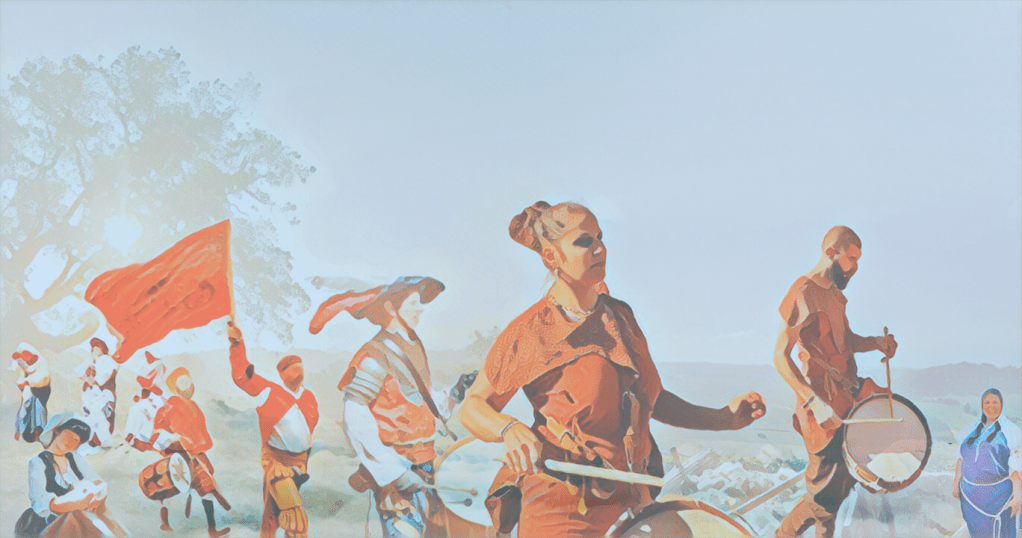
I had entered a time machine, not to medieval Portugal, but to my own youth in 20th century California. When the drums played in Óbidos, I could close my eyes and picture the parade at my Renaissance Faire. Not just any parade, the queen’s progress. Technicolor Landsknechts, giant flags turning like windmill arms, stirring up the familiar sense of anticipation.
Even now, when that parade goes by me at the Renaissance Faire, I am eight years old again. I can remember how it felt, those drumbeats are so loud, and my body used to be so small. The sound went all the way through me. I used to have to look up at everything, so the pikes seemed to stretch up high enough to snag the clouds. Everything was so colorful. The people marched by me like a kaleidoscope, all colors and dust and sound.
The actress who played the queen when I was a child didn’t feel like an actress to me. She felt like a queen. Not in the sense of governmental or economic systems, I had no interest in monarchies. It was more that the existence of this bejeweled and benevolent queen suggested that there should also be fairy godmothers, and talking bears, and epic quests that a small girl could go on alone, and if she were good, and brave, and clever, she could make her fortune by the time she came out of the forest. As a child it felt like anything was possible at the faire.
The Original Renaissance Pleasure Faire was founded as an educational event. Coming of age as a faire brat was definitely educational. Even as an adult the faire has a way of showing people that they can grow without necessarily growing up. There are always lessons yet to be learned. That’s not just true for my renaissance faires, apparently it’s true for all of them. Teary-eyed with joy and nostalgia in the shadow of Óbidos Castle, I was reminded yet again that it isn’t the place that matters. It’s the community.
Sometimes it feels like the memory is all that’s left of our used-to-be
But what can never be denied is the way we changed inside
I guess you had to be there to be where
Love belonged to everyone
Janis Ian,
Guess You Had to be There


Leave a comment